
“Be fruitful, and multiply, and replenish the earth, and subdue it…”
—Genesis 1:28 (KJV)
We’ve read these words so many times, they can feel like background noise. A divine command tucked into the opening lines of Genesis, like instructions pinned to the doorframe of Eden.
Thanks for reading! Subscribe for free to receive new posts and support my work.
But what if we read them again—not just as a historical mandate, but as a prophetic promise?
God’s first words to humanity weren’t merely about reproduction. They were about expansion. Multiplication. Growth. The forward motion of life. “Fill the earth,” He said. And then, as if to emphasize it again, He repeated it to Noah after the flood: “Be fruitful, and multiply, and replenish the earth” (Genesis 9:1).
And here’s the part that arrests my thoughts:
That command has never been revoked.
Even as populations rise, cities swell, and environmentalists warn of planetary limits, God’s original design still echoes in the air: fill the Earth.
To some, that might sound like a looming crisis. But what if it’s not a curse?
What if it’s a promise?
When God Speaks, Reality Bends
Isaiah 55:11 declares that God’s word never returns void. It always accomplishes what He sends it to do. And Numbers 23:19 reminds us: God is not a man, that He should lie.
Which means this: if God told humanity to fill the Earth, He also built the Earth to be filled. He wrote it into the structure of creation itself.
We may look at limited resources, congested cities, and melting glaciers and wonder, How could the Earth possibly sustain more? But perhaps we’re looking at the problem from the wrong angle.
Maybe the better question is:
How did God set up the Earth to make this command possible?
Not Just Around Us, But Above Us
We tend to think horizontally. When we hear “fill the Earth,” we picture migration across land—settlements spreading to every corner of the globe. And we’ve done that. For centuries, humanity has pushed outward: across oceans, into deserts, up mountains.
But what happens when there’s nowhere else to go outward?
Where do we grow next?
Could it be that Earth was made not just to be spread across, but also grown into—upward, layered, multidimensional?
After all, forests don’t just spread; they rise. Mountains don’t crawl; they reach. Even our breath moves in cycles—up through trees, down through lungs, back into the atmosphere. Why wouldn’t human expansion follow the same vertical logic?
Enter the World Tree
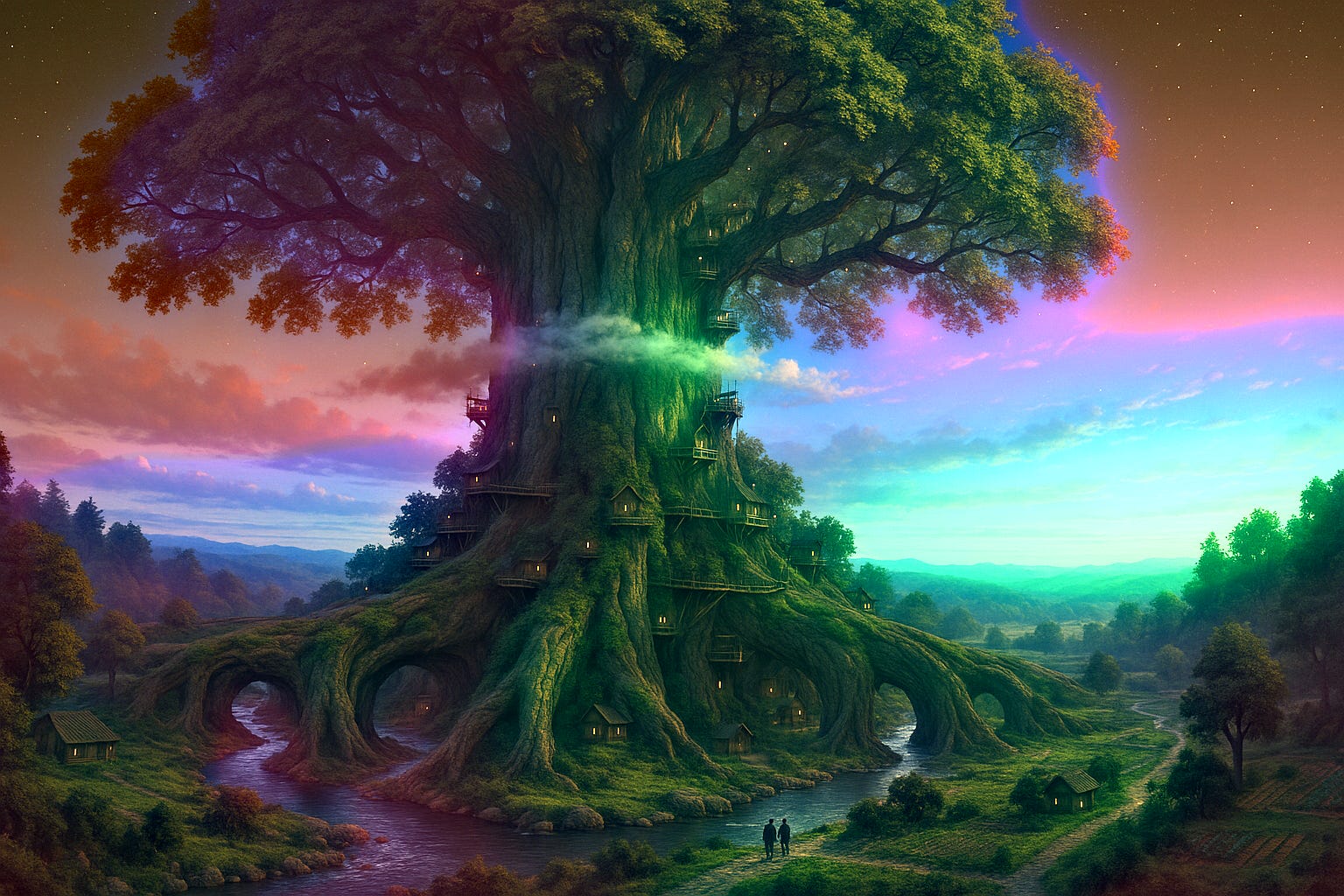
It might sound like fantasy, but ancient cultures weren’t afraid to imagine it: the World Tree, a living structure tall enough to bridge earth and heaven, vast enough to sustain life in its canopy.
What if that imagery isn’t just myth, but intuition?
What if God embedded into our imagination the idea of vertical ecosystems—not sterile skyscrapers or steel towers, but living architecture? Communities rooted in the ground but dwelling in the sky. Tree-cities designed not against nature, but with it.
This isn’t about building Babel again. It’s about asking: could there be a way to extend life upward in harmony with the breath of creation?
Breath and Fire and Growth
Of course, such an idea raises questions. Can trees even grow that big? What about oxygen, structure, sustainability?
But the deeper you look, the more beautifully things begin to align.
Humans exhale carbon dioxide. Trees inhale it. Fires—natural and even human-made—release it into the air. And in return, trees gift us oxygen. It’s a system of mutual exchange. A design. A rhythm.
Maybe the Earth isn’t breaking under our presence.
Maybe it’s waiting for us to become part of the design again.
Romans 8 says that “the whole creation groaneth and travaileth… waiting for the manifestation of the sons of God.” The world is waiting—for us to rise into our calling, to live as stewards, not consumers. Maybe even to plant the kind of trees that don’t just feed us, but house us.
But What About Babel?
Of course, the Tower of Babel looms large in any conversation about vertical ambition. The people in Genesis 11 said, “Let us build us a city and a tower… lest we be scattered upon the face of the whole earth.”
And that’s the key. It wasn’t the height that drew God’s judgment—it was the motive. They resisted dispersion. They clung to sameness. They built not out of obedience, but defiance.
But what if we have already scattered?
What if, having fulfilled the outward motion, it’s time to consider the upward one—not in pride, but in partnership?
Imagine a world where humanity doesn’t build to defy God, but to dwell in His rhythm. Where our buildings breathe. Where our cities sing with wind and roots. Where the old command to fill the Earth finds a new dimension of fulfillment.
Maybe This Is the Way Forward
In Ezekiel 31, God describes the Assyrian empire like a towering cedar in Lebanon—branches spread wide, roots deep, giving shade to the nations. In Psalm 1, the righteous are called trees, planted by rivers of water. In Revelation 22, the Tree of Life stands at the center of the New Jerusalem, feeding the nations, healing the world.
Trees aren’t just poetic metaphors. They’re models of kingdom life.
Rooted. Reaching. Life-giving. Vertical.
Maybe we were never meant to cap our growth with fear.
Maybe God’s design is deeper, taller, and more interconnected than we’ve imagined.
Maybe when we were told to “fill the Earth,” it wasn’t just a population mandate.
Maybe it was an invitation to become co-creators—partners in a living system that still has room to rise.
Not towers of pride.
But trees of life.
Reflection Questions:
- What does “filling the Earth” mean to you—personally, spiritually, or environmentally?
- Have you ever considered vertical growth as a part of God’s design?
- What might it look like to build “World Trees” in your own life—structures or systems that are both sustainable and sacred?
Thanks for reading! Subscribe for free to receive new posts and support my work.